What Is Ambient Voice Ordering? How Tableside Capture Works Without a Screen
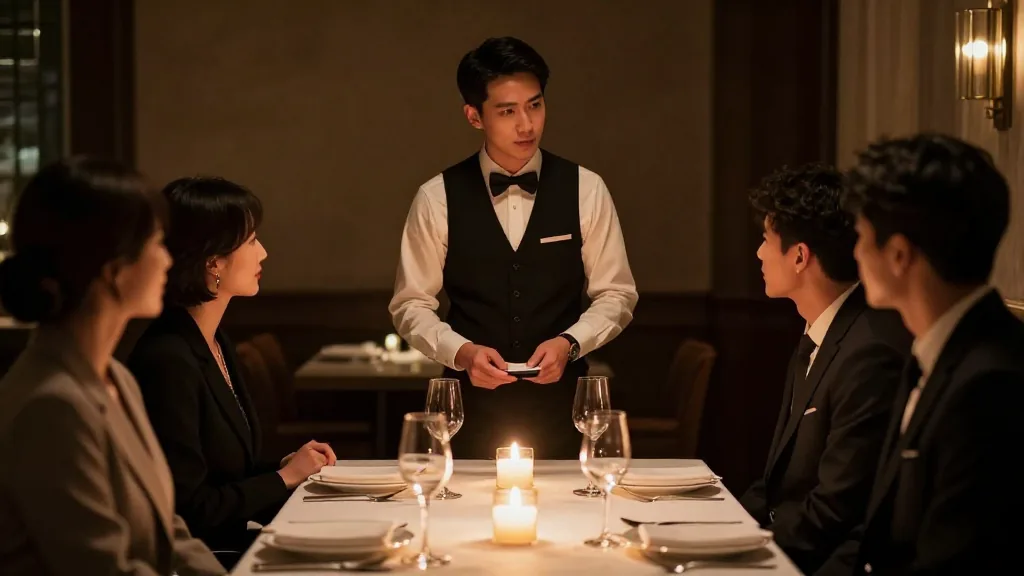
Every few years a technology arrives that the industry insists on describing by what it removes. The dishwasher removed the pot sink. The reservation platform removed the paper book. Ambient voice ordering removes the screen from the table — and because it removes something instead of adding a shiny new object, it is easy to misunderstand. This article draws the line precisely: what ambient capture is, how it is different from the handheld in your server's apron and the bot in the drive-thru lane, and what actually has to happen between a spoken sentence and a fired kitchen ticket.
The word doing all the work is "ambient"
Start with the adjective, because it carries the whole definition. Ambient means the capture is part of the environment, not part of the interaction. Nobody picks up a device, nobody addresses a machine, nobody changes how they speak. The order is lifted from a conversation that would have happened word-for-word even if the technology were switched off.
Contrast that with every other voice product a restaurant meets. A drive-thru bot is interactive — the guest is talking to it. A phone agent is interactive in the same way. Even a server dictating into a headset is a form of directed speech: they are speaking at the system, choosing their words for the machine. Ambient capture is the only model where no human on either side is performing for a microphone. That single property is what makes it feel like hospitality instead of a transaction, and it is also what makes it the hardest audio problem in the category.
If you want the umbrella concept that ambient capture sits under, we laid out the full pipeline in what is speech-to-order. Ambient voice ordering is one specific deployment of that pipeline — the one aimed at the table, where the server stays the counterparty and the machine's highest ambition is to go unnoticed.
What it is not
Buying mistakes almost always start here, because four different products get filed under the same three words. Here is the honest separation.
| Model | Who addresses the machine | Guest touches a device? | Where it lives |
|---|---|---|---|
| Ambient voice ordering | No one — it listens to a conversation | No | Full-service and fine dining tables |
| Handheld POS terminal | The server, by typing | No, but a screen is present | Casual and full-service floors |
| Tableside kiosk / tablet | The guest, by tapping | Yes | Casual dining, high-turn |
| Drive-thru / phone voice bot | The guest, by speaking to it | No, but the machine is the counterparty | QSR lanes, off-premise calls |
The closest relative in that table is the handheld, and the difference is worth being precise about because it is the comparison every operator makes first. A handheld does not require the guest to do anything — but it puts a screen between the server and the guest and demands the server's eyes and thumbs. We walk through that trade in detail in our handheld POS versus voice ordering comparison. Ambient capture's whole thesis is that in a room where the server is the product, the screen is a tax on presence, and paying it dozens of times a night quietly erodes the thing guests came for.
The other cousin — the guest-facing voice bot — is where most restaurants encounter voice technology first, usually on the phone. The engineering overlaps heavily with ambient capture; the service design does not. If the phone is your entry point, the operational case is laid out well in this comparison of AI voice ordering systems for restaurants. On the phone the machine is the host. At the table it must never be.
Inside the ambient pipeline
Strip away the marketing and ambient capture runs the same skeleton as any speech-to-order system, but every stage is harder because the microphone is farther away and the audio was never meant for a machine.
1. Capture. A microphone — most often a small array worn or carried by the server, sometimes a fixed beamforming unit near the table — converts the conversation into a signal. Distance is the enemy here. A close-talk mic at 10 cm gives a signal-to-noise ratio 12 to 20 dB better than a device sitting 90 cm away on the table, and no downstream software recovers what the microphone never cleanly heard. This one decision sets the ceiling for everything else, which is why we go deep on it in our guide to microphones and accuracy in noisy dining rooms.
2. Voice activity and speaker separation. Ambient audio contains two, three, sometimes five people talking, plus music and the table behind. The system has to find the order inside the small talk and attribute lines to the right speaker — the guest asking for "the branzino, no capers" versus their companion still deciding. Directed models never face this because only one person is addressing them. Ambient models face it every single ticket.
3. Transcription. An acoustic model turns the relevant speech into words. Clean, close-mic English sits around 4 to 8 percent word error on modern engines; a 78 to 88 dB dining room with overlapping talkers and accents commonly doubles or triples that. The raw transcription number a vendor quotes is close to meaningless for ambient use unless it was measured in a real room.
4. Menu mapping. The transcript is matched against your live catalog — the actual items, modifiers, prices and 86 list — with fuzzy and phonetic matching and a per-restaurant lexicon. This is the layer that separates a product from a science project. A system that knows orecchiette, bánh mì and your bartender's nickname for the house Negroni will beat a better transcription engine that does not, every time.
5. Modifier resolution. "The short rib, medium rare, no shallots, sauce on the side" has to resolve into a required temperature choice, a negative modifier, and a kitchen instruction — three different objects, not one string of text. Modifier depth is where most demos quietly stop, and where allergies live, so the stakes are real. We treat that risk directly in voice notes to the kitchen: modifiers, allergies and special requests.
6. Confirmation through the read-back. Here is the quiet genius of the ambient model: the accuracy check already exists. A good server reads the order back to the table before they leave it. Ambient capture treats that read-back as its verification step — the guest confirms or corrects while the model's proposed ticket is still editable and everyone is still sitting there. No screen workflow enforces a human confirmation this reliably.
7. Write to the POS. The structured order posts to the check with the right seat, the right course and the right fire timing. If that integration is one-way, delayed, or drops the modifiers, everything upstream is decoration.
KwickVoice is an early-stage product in private pilot. The figures in this article are industry and engineering ranges drawn from public benchmarks and general field practice — not performance claims about our own system, which we deliberately do not publish while the pilot is running.
The math operators actually care about
Skip the word "efficiency" and count minutes and mistakes instead. Take a 110-seat full-service room turning 180 covers on a Saturday with an average party of 2.7 — call it 67 checks. Most tickets get touched at a terminal two or three times across a meal: the first entry, a second round, dessert. Say 2.4 trips at 45 seconds each, including the walk and the wait for an open station. That is roughly 120 minutes of terminal time in a single shift — not one dramatic block, but a hundred small subtractions, each a moment a server stood at a screen instead of in their section.
At a fully loaded server cost near $23 an hour, the labor line alone is about $46 a shift, or roughly $2,400 a year for one weekend night. That is the visible number. The invisible one is bigger: order-accuracy studies across full service land consistently between 2 and 5 percent of tickets needing a remake or comp. At 67 checks, 3 percent is two problem tickets a night. A remade $34 entrée at 28 percent food cost burns about $9.50 in product, plus the labor to make it twice, plus the table's patience — and two a night, six nights a week, is roughly $6,000 a year in food that never reached a guest, appearing nowhere on your P&L as a line item.
Be honest about what ambient capture does and does not do to those numbers. It does not delete them. It shifts where errors originate — away from re-keying at a terminal and toward acoustics and mapping at the table. The reason a well-designed ambient system still comes out ahead is the read-back: a verification step that already lived in the service and that no screen enforces as consistently.
What accuracy really depends on
Vendors quote a transcription accuracy figure. On its own it tells you almost nothing about how ambient capture will perform in your room. Five factors drive the real outcome, roughly in order of impact.
- Microphone type and distance. Worth more than any model choice. The single largest lever, and the one most demos hide by running in a silent showroom.
- Menu constraint. Matching speech against 180 known items with known modifiers is a far easier problem than open-vocabulary transcription. A tight lexicon can cut effective error rates by half or more.
- Room acoustics. Hard surfaces and long reverberation — anything past about 0.8 seconds RT60 — smear consonants together and hurt more than raw loudness does.
- Speaker familiarity. Systems that adapt to your specific staff over a few hundred tickets beat cold models substantially, especially for accented English and code-switching — which matters enormously for the multilingual teams most kitchens run, covered in multilingual voice ordering for diverse restaurant teams.
- Confirmation design. Whether the workflow forces the read-back, and whether a correction takes one gesture or five.
Where ambient capture belongs — and where it doesn't
A technology that claims universal fit is usually one that has not been tested honestly. Ambient voice ordering is a specific tool for a specific room. It fits where the server is central to the experience, where the read-back is already a ritual, and where a glowing rectangle at the table would read as a downgrade. That is fine dining, elevated full service, chef-driven rooms — the slice of the industry that has been least well served by ordering technology for twenty years, precisely because every previous product asked the server to look away from the guest. We make the category argument in full in voice ordering for fine dining: a new category, and trace how tableside ordering arrived here in our tableside ordering technology guide.
It is a poor answer for counter service, where the guest already stands at a screen and self-direction is faster. It is a poor answer for high-volume quick service, where the binding constraint is throughput per lane, not presence. And it is a poor answer for any room with turnover so high that no server is on the floor long enough to build the habit — which is exactly why rollout, not hardware, tends to decide outcomes. We wrote a full two-week rollout plan for training servers on voice ordering for that reason.
Questions to ask before you believe a demo
Ambient claims are easy to make in a quiet showroom and hard to keep on a Friday at eight. Bring these to any vendor conversation.
- Run the demo in a room with music and a second table of talkers. What happens to accuracy?
- How does the system attribute lines when two guests at the table order at once?
- Order a four-modifier item by voice, live. Does every modifier land as a structured object?
- What is the correction path when it gets an item wrong — and how many taps is it?
- Does it write to my POS in real time, and what happens to the ticket if the network drops for 90 seconds?
- Where is audio processed, how long is it retained, and what disclosure does my state require for capturing conversation?
- What does month two look like — after the novelty, when a new server starts mid-shift?
That last question matters most, and it is the one glossy decks skip. For the broader picture of how AI-driven voice is reshaping restaurant ordering across the phone, the counter and the table, this overview of how AI voice ordering works for restaurants is worth the read.
See where ambient voice fits in a full restaurant stack
Ambient capture only pays off when the ticket lands cleanly in the point of sale, the kitchen display and the reporting behind them. Learn more about how KwickOS connects the pieces.
Explore the KwickOS platformFrequently asked questions
What is ambient voice ordering?
Ambient voice ordering is a form of speech-to-order in which the system listens to the natural conversation between a server and a guest and builds a structured point-of-sale ticket from it, with no device the guest touches or talks to. The server takes the order exactly as they always have; the capture happens in the background.
How is ambient voice ordering different from a handheld POS?
A handheld puts a screen between the server and the guest and requires the server to type or tap each item. Ambient capture removes the screen from the interaction entirely: the server keeps eye contact and their hands free while the system assembles the ticket from what was said, then confirms it through the read-back the server already does.
Does the guest talk to a computer with ambient voice ordering?
No. That is the defining line. The guest talks only to the server. Ambient capture is not a drive-thru bot or a phone agent, where the machine is the counterparty. At the table the machine's goal is to go unnoticed while two people have a normal conversation.
How accurate is ambient voice ordering in a busy dining room?
Accuracy is driven far more by the microphone and the menu-mapping layer than by the transcription engine. Ambient capture faces the hardest audio conditions of any voice deployment because the microphone sits farther from the mouth. A constrained menu vocabulary and the server's spoken read-back are what recover the accuracy that distance and room noise cost.
What kind of restaurant is ambient voice ordering for?
Full-service and fine dining, where the server is central to the experience and a glowing screen at the table reads as a downgrade. It is a poor fit for counter service and high-volume quick service, where the guest is already at a screen and raw throughput, not presence, is the constraint.