Multilingual Voice Ordering for Diverse Restaurant Teams
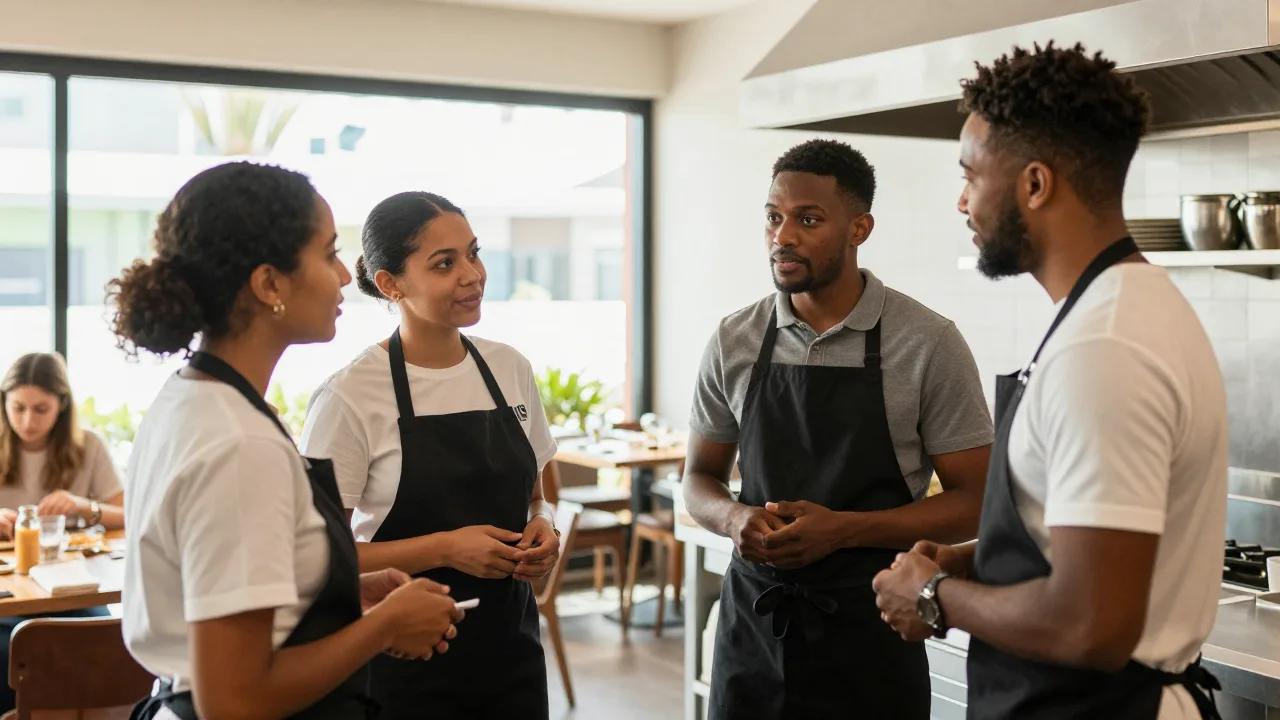
A 62-seat neighborhood restaurant loses about $180 on a Saturday to one recurring mistake. A server whose first language is Spanish enters a modifier as "sin cebolla" in the notes field because the terminal has no button for it. The line cook, who reads Spanish fluently, never sees the note — it printed at the expo station, in English, truncated at 24 characters. The plate goes out with onion. The table sends it back. Two more covers wait an extra eleven minutes because the sauté station is now cooking a redo during the 7:45 push.
Nobody in that chain did anything wrong. The system did. It assumed one language, one keyboard layout, and one reader — and an American restaurant floor has not looked like that in a very long time. Walk into most independent kitchens tonight and you will hear two or three languages inside ten minutes, often inside a single sentence. Ordering technology has been slow to catch up, and voice is where the gap becomes impossible to ignore, because voice is the first interface that makes staff use their actual speech instead of translating themselves into buttons.
Three language problems, not one
"Multilingual support" gets sold as a checkbox. In a restaurant it is three separate problems with three separate fixes, and vendors routinely solve one and market all three.
| Problem | Where it happens | What it needs |
|---|---|---|
| Guest to server | At the table | Human hospitality; technology mostly stays out of the way |
| Server to system | Voice capture | Accent tolerance, code-switch handling, a bilingual menu lexicon |
| System to kitchen | Tickets, KDS, expo | Per-destination rendering from one structured order |
Most attention goes to the first problem, which is the one technology should touch least. The second and third are where the operational money sits.
Accent is not an error, but most systems treat it as one
Speech recognition quality is not evenly distributed. Models trained predominantly on native-speaker North American English perform measurably worse on accented English, and independent evaluations have repeatedly found error rates on some speaker groups running roughly one and a half to three times higher than on the reference group. In casual conversation that shows up as an annoyance. In an ordering system it shows up as a comped entrée.
The gap concentrates exactly where restaurants are most exposed: proper nouns. Everyday sentence words have huge amounts of training data behind them. Cavatelli, bavette, bibimbap and chilaquiles do not — and when they are spoken with the phonology of a language that isn't English, the decoder is guessing from a thin prior.
Two mechanisms close most of that gap, and neither requires waiting for a better foundation model. The first is per-speaker adaptation: a system that keeps a lightweight profile for each staff member and adjusts to their pronunciation over their first few hundred tickets. The second is vocabulary constraint. Matching against 180 dishes you actually sell is a far narrower problem than open transcription, and a good lexicon carries multiple pronunciation variants per item — the Italian-correct version, the American-server version, and the two your regulars use.
Code-switching is the normal case, not the edge case
Here is a sentence that gets spoken in thousands of kitchens every night: "dame dos de esos, and the branzino, sin cebolla, para la mesa seis." One clause of Spanish, one of English, a Spanish modifier, a Spanish table reference.
A system with a language toggle handles that badly. Set it to English and the Spanish evaporates or comes back as nonsense; set it to Spanish and the dish name garbles. The toggle itself is the design error — it forces a person to pre-declare a language before they have finished thinking, which is not how bilingual speakers work. Fluent code-switchers switch mid-clause, unconsciously, and asking them to stop is asking them to be slower and less themselves during the busiest hour of the week.
Practical handling comes down to three choices. Use a multilingual model that decodes a shared phonetic space rather than one language at a time. Carry the menu lexicon in every language the floor uses, so "pollo" and "chicken" resolve to the same item code. And handle numbers and quantities in both languages explicitly, because numbers are where switching happens most and where errors are most expensive — "dos" and "dose" are one bad frame apart, and one of them puts two entrées on a table that wanted one.
KwickVoice is in private pilot. The ranges in this article come from published speech-recognition evaluations and general operational practice, not from measurements of our own system, which we do not publish while the pilot runs.
Dish names belong to nobody's dictionary
A restaurant menu is a pile of loanwords. A single mid-priced American menu can easily carry Italian, French, Spanish, Japanese and Vietnamese terms on the same page — and each one has at least two spoken forms in circulation: the one a native speaker of the source language uses, and the naturalized version your dining room uses.
The fix is not clever modeling; it is boring data hygiene. For every item on the menu, record the alternate spoken forms your team actually says, including the shorthand. Servers do not say "the wild-caught branzino with fennel and citrus." They say "the branzino," "the fish," and, in one restaurant I know well, "the sea bass" — because that is what guests call it and correcting them is bad hospitality. All three need to resolve to one item code.
Budget the time honestly: roughly two to four hours for a 150-item menu the first time, then twenty minutes a season. The payoff is the largest single accuracy improvement available to most restaurants, and it is available before you buy anything. The mechanics of that mapping layer are covered in more depth in our explainer on how speech-to-order works.
Render the ticket per destination, not per order
The third problem is the one that pays back fastest, and it is purely a software design question. Keep one structured order — item codes, modifier codes, seat, course, fire timing — and render it separately for each destination.
- Guest-facing receipt: the language the guest was served in.
- Expo screen: whatever the expo reads fastest under pressure.
- Station tickets: per-station language. The grill can read Spanish while the wok station reads Chinese, from the same order.
- Manager reporting: one canonical language so the numbers reconcile.
This only works if modifiers are structured objects rather than free text. Free-text notes cannot be translated reliably, they get truncated by ticket width, and they are the exact place where allergy information goes to die — a failure mode we take apart in detail in voice notes to the kitchen: modifiers, allergies and special requests. If you take one structural lesson from this article, take that one: structure the modifier, and language stops being a translation problem and becomes a rendering problem.
What this does to hiring
There is an uncomfortable truth under all of this. In a lot of restaurants, comfort with the ordering terminal has quietly become a hiring filter — not for the job, but for the software. A candidate with fifteen years of floor experience gets passed over because the POS is English-only and the training window is one shift.
Voice changes that calculus, because speaking is the one skill every candidate already has at native fluency in at least one language. Operators who make this shift tend to describe the same two effects: new servers reach full-section confidence noticeably faster, because there is less to memorize about the software, and the candidate pool widens in markets where it had gotten painfully thin. The staffing side of that dynamic is explored well in this piece on hiring bilingual staff in Asian restaurants, and the same logic applies across cuisines.
There is a guest-facing version too. Language capability on the phone and in ordering channels has become a competitive line rather than a courtesy — the reasoning behind that is laid out in this argument for serving guests in any language they call in.
An implementation checklist
- Inventory your real languages. Walk the building on a Friday and write down what you hear. Count front of house and back of house separately; they are rarely the same list.
- Build the multilingual lexicon. Every item, every alternate spoken form, every shorthand. This is the highest-leverage two hours in the project.
- Structure every modifier. If "no onion" only exists as free text, fix that before you evaluate voice at all.
- Set per-station rendering. Decide what language each printer and screen speaks, and ask the people who read them rather than guessing.
- Turn on per-speaker profiles. Confirm the vendor supports adaptation, and confirm what happens to that profile when someone leaves.
- Measure per-speaker accuracy. Not a floor average — a per-person breakdown, reviewed monthly.
- Fix the system, not the person. Make it explicit to managers that a low per-speaker score is a lexicon or microphone finding, not a performance one.
Step six deserves emphasis because it is where fairness becomes measurable. If one server's error rate is double the floor average, that is a data problem you can solve — usually with pronunciation variants or a better microphone, as covered in our field guide to microphones and accuracy in noisy dining rooms. If you never break the number out per person, it hides inside an average that looks fine and quietly turns into a coaching conversation aimed at the wrong target.
What to expect in the first month
Multilingual capability makes rollout slower before it makes it faster. Plan for three to four weeks before per-speaker accuracy stabilizes, and expect the first week to look worse than the pilot did, because pilots are usually run by the manager who speaks the system's best-supported language. Build the schedule accordingly — our two-week rollout plan assumes exactly this shape, with a deliberate lexicon-correction loop in the first several days.
And set the expectation with the team plainly on day one: the system is being trained to understand them, not the other way around. That single sentence, said out loud in a pre-shift, changes how a floor reports errors — from quiet embarrassment to useful data.
One order, every language your building speaks
Multilingual only works when the point of sale, kitchen display and reporting share one structured order. KwickOS is built around that single record.
Explore the KwickOS platformFrequently asked questions
Can voice ordering handle accented English?
Yes, but not equally well out of the box. Speech models trained mostly on native-speaker recordings show noticeably higher error rates on accented English, and the gap is widest on unfamiliar proper nouns such as dish names. Per-speaker adaptation over a few hundred tickets plus a constrained menu vocabulary closes most of it.
What is code-switching and why does it break voice ordering?
Code-switching is changing language mid-sentence, as in "dos de estos, plus the branzino." Systems locked to one language per session either mistranscribe the switched words or drop them, because the decoder is only searching one vocabulary. Handling it requires either a multilingual model or a menu lexicon that carries every dish name in each language your staff uses.
Should kitchen tickets print in Spanish or the guest language?
Kitchen tickets should print in whatever language the line reads fastest, which is frequently not the language the order was placed in. Modern systems keep one structured order and render it per destination, so the guest receipt can read English while the expo screen reads Spanish and the wok station reads Chinese, all from the same item codes.
How many languages does a restaurant voice system need to support?
Count the languages actually spoken on your floor rather than shopping for the longest list. A typical American independent restaurant runs on two or three, most often English plus Spanish and frequently a third such as Mandarin, Cantonese, Vietnamese or Korean. Deep support for your real three beats shallow support for forty.
Does multilingual voice ordering help with hiring?
It widens the pool. When the ordering system accepts a server's strongest language and renders the ticket into whatever the kitchen reads, fluency in the ordering software stops being a hiring filter. Operators who make that change typically report faster ramp-up for new hires and access to candidates they previously had to pass on.