Voice Ordering in Noisy Dining Rooms: Microphones and Accuracy
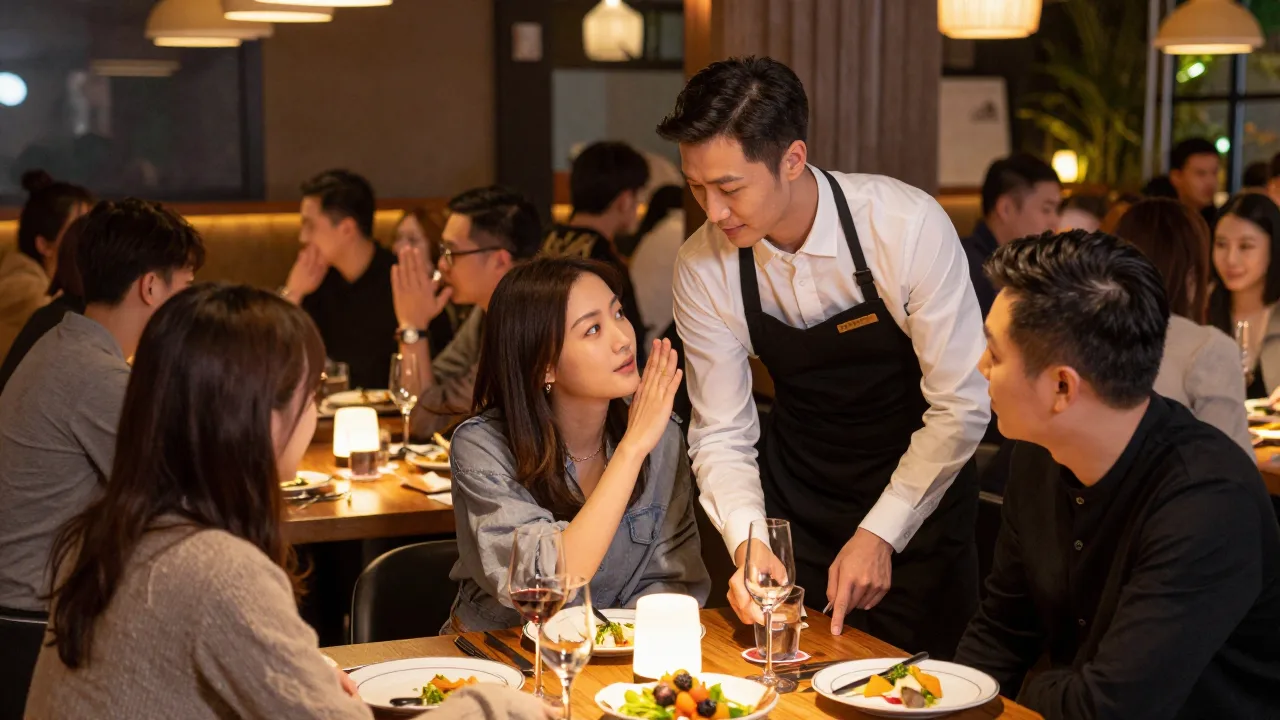
It is 8:40 on a Friday, the room is three deep at the bar, and a manager is holding a phone with a sound-meter app that reads 84 dB. On the pass sit two remade entrées. The voice capture the restaurant piloted for six weeks worked beautifully in the vendor's conference room and beautifully at 3pm on a Tuesday, and it is now producing garbage at exactly the hour when a mistake costs the most.
This is the single most common way restaurant voice projects die, and the frustrating part is that it is almost never a software problem. The team spends three weeks arguing about transcription engines when the actual fault is 70 centimeters of air between a mouth and a microphone. Noise is a physics problem first. Treat it as one and it becomes tractable; treat it as a model-selection problem and you will burn a season.
The number that matters is the gap, not the level
Every operator asks "how loud is too loud." It is the wrong question. What determines whether a phrase survives is signal-to-noise ratio: how far the talker's voice rises above everything else arriving at the microphone. A 90 dB room with a mic at the lips can be easier than a 70 dB room with a mic across the table.
Practical thresholds are well established. Above roughly 15 dB of SNR, speech recognition performs close to its clean-audio ceiling. Between 10 and 15 dB, accuracy degrades gently and a read-back covers the difference. Below 5 dB, error rates climb steeply and no amount of post-processing saves the ticket — the information simply is not in the recording.
Here is the leverage: sound pressure falls about 6 dB every time you double the distance from the source. Move a microphone from 80 cm to 20 cm and you gain roughly 12 dB of signal while the room noise stays exactly where it was. That single change is worth more than switching transcription vendors, and it costs nothing but a design decision.
What a dining room actually measures
Most operators have never put a meter in their own room, and are surprised by the results. Rough ranges from typical service, measured at seated head height:
| Setting | Typical A-weighted level | What it does to capture at 60+ cm |
|---|---|---|
| Empty room, HVAC only | 42–52 dB | Effortless; every demo happens here |
| Fine dining, half full, no music | 58–66 dB | Workable with a good array |
| Full-service, Friday 8pm | 74–84 dB | Table devices start dropping modifiers |
| Bar-forward room with live music | 86–95 dB | Close-talk mic or nothing |
| Open kitchen pass at fire | 80–90 dB | Hearing protection territory, not capture territory |
Two effects compound at the top of that range. First, the Lombard effect: people involuntarily raise pitch and volume in noise, which changes the acoustic signature enough that models trained on calm speech get measurably worse. Second, the interference is other voices — and a competing talker is the one noise source that every suppression algorithm handles badly, because it looks exactly like the thing you asked the algorithm to keep.
Four microphone architectures, compared honestly
This is the decision that determines everything downstream. The trade is always the same: physics versus how the thing looks on a floor where appearance is part of the product.
| Architecture | Distance | Real-world SNR at 82 dB room | Typical cost | Honest verdict |
|---|---|---|---|---|
| Discreet close-talk cardioid (lapel/collar) | 10–15 cm | +12 to +18 dB | $120–$260 | Best capture; requires a wearable staff will actually keep on |
| Boom headset | 3–5 cm | +18 to +25 dB | $90–$180 | Unbeatable audio, unacceptable in a fine-dining room |
| Handheld pocket device, raised to speak | 20–30 cm | +6 to +12 dB | $150–$300 | Good, but reintroduces a gesture at the table |
| Table-mounted beamforming array | 60–100 cm | 0 to +6 dB | $250–$500 | Looks the best, performs the worst at peak |
Consumer earbuds deserve their own warning. At $45 a pair they are the obvious starting point, and they are the most common reason a pilot produces confusing results. Their noise processing is tuned for phone calls, which means it is tuned to make speech sound pleasant, not to preserve it faithfully. That processing preferentially removes high-frequency fricatives — the /s/, /f/, /th/ sounds that distinguish "fish" from "chips," "no ice" from "no nuts." Perceived quality goes up, machine accuracy goes down, and no one on the team can explain why.
Reverberation: the failure mode nobody measures
Volume is what people notice. Reverberation is what actually breaks recognition. When a room is built from concrete, glass, tile and reclaimed wood — which is to say, when it is built the way restaurants have been built for fifteen years — sound arrives at the microphone multiple times, milliseconds apart, and consonant boundaries smear into each other.
The metric is RT60, the time for sound to decay by 60 dB. Under about 0.6 seconds, speech stays crisp. Between 0.6 and 1.0, accuracy slides. Past 1.2 seconds, both humans and machines start guessing, which is why guests in those rooms say "what?" all night and then blame the menu font.
The fixes are unglamorous and they work: ceiling clouds or acoustic baffles at roughly $18 to $40 per square foot installed, upholstered banquettes instead of bare bench seating, heavy drapery on at least one long wall, and felt or cork under tabletops. A room that drops from 1.1 to 0.6 seconds RT60 gains recognition accuracy and gets a measurable bump in how guests describe the noise level in reviews. That is a rare piece of overlap between an engineering fix and a hospitality one.
KwickVoice is in private pilot. Every figure here is drawn from published acoustics literature, hardware spec sheets and general field practice — not from measurements of our own product, which we are not publishing while the pilot runs.
What software can and cannot fix
Signal processing is genuinely useful. It is not magic, and vendors are vague about the boundary, so here it is plainly.
Works well: steady-state noise removal (HVAC hum, refrigeration, dish machine drone), echo cancellation when a speaker and mic share a device, automatic gain control across talkers with very different volumes, and beamforming when the geometry is fixed and known.
Works poorly: separating two humans talking at once, recovering a clipped syllable, undoing reverberation after the fact, and anything at all below about 3 dB SNR. If the phrase is not in the recording, no model retrieves it — it only hallucinates something plausible, which in an ordering context is worse than an obvious blank.
The most valuable software layer is not the acoustic one at all. It is the menu-mapping layer that constrains the search space to items you actually sell. Matching a smeared phrase against 180 known dishes with known modifier combinations is a dramatically easier problem than open-vocabulary transcription, and it is where a system tuned to your restaurant beats a generically better engine. The mechanics of that layer are covered in our explainer on what speech-to-order is and how the pipeline works.
Push-to-talk beats always-listening in a loud room
Open-mic capture sounds more elegant. In practice, a deliberate capture window — a discreet press, a wake gesture, a fixed few seconds — outperforms it at peak volume for three reasons.
First, it fixes the endpointing problem: the system knows exactly when the order starts and stops, instead of guessing amid continuous speech and clipping first syllables. Second, it cuts processing volume and cost by an order of magnitude, since you are transcribing 90 seconds a table rather than four hours a shift. Third, and least technical, it is far easier to explain to guests and to your state's recording-disclosure rules when capture is a bounded, intentional act rather than a room that is always on.
The trade is that it puts a small gesture back into the service moment. Whether that is acceptable depends on the room, and it is exactly the sort of choice that should be made with servers rather than for them. The wider set of ordering channels and where each one belongs is mapped out in this rundown of the different ways guests can place an order.
The read-back is your error-correction layer
Every serious deployment leans on a habit that predates the technology by a century. The server repeats the order aloud: "the branzino, the short rib medium rare, no shallots — anything else?" That sentence is spoken deliberately, at a controlled pace, usually leaning in toward the table.
Three things make it the highest-value audio in the entire service. It is the clearest speech of the interaction. It is structurally predictable, which makes it far easier to parse. And it is the one moment where a mistake gets caught by the only auditor who matters — the guest, still sitting there, before the ticket fires. A system that treats the read-back as its source of truth gets stronger in a loud room rather than weaker, because the read-back is the one thing servers naturally do louder when the room is loud.
A 45-minute protocol to test your own room
Do not accept a demo in a quiet office. Run this instead, in your building, during service. It takes one manager and forty-five minutes.
- Build a 30-order script. Include your five hardest dish names, three items that sound similar to each other, four orders with three or more modifiers, one allergy call-out, and two orders where a second guest interrupts mid-sentence.
- Log the room. Take a dB reading at three tables at the top of the test and again at the end. Note music level and whether the patio doors are open.
- Run it live at peak. Three different staff members, ideally including one non-native English speaker and one fast talker, at real tables.
- Categorize every miss. Not a single accuracy percentage — split it into wrong item, dropped modifier, wrong quantity, wrong seat, and total failure. These have very different operational costs.
- Repeat the identical script at 3pm in the empty room. The delta between the two runs is your real noise penalty, and it is the number that predicts month two.
A useful benchmark from that exercise: if dropped modifiers are more than about 4 percent of tested orders, you have a capture problem, not a training problem. If wrong items dominate instead, your menu lexicon needs work. And if the errors cluster around one staff member, look at accent handling and per-speaker adaptation before you blame the person — the practicalities of that are covered in multilingual voice ordering for diverse restaurant teams.
Budget the whole thing, not just the software
A realistic first-room budget for a 12-server floor: audio hardware at $120 to $260 per active device, spares at 20 percent because things get dropped in dish pits, charging infrastructure at $200 to $400, and acoustic treatment somewhere between $0 and $9,000 depending on how hard your room is. Software and per-ticket processing are usually the smallest line. The broader context for where this sits in a full technology stack is laid out in this practical guide to AI voice ordering for restaurants.
Then budget the thing everyone forgets: the two weeks of rollout during which accuracy will be worse than the pilot suggested, because habits are still forming. We put that schedule in writing in our two-week server rollout plan, and the kitchen-side conventions in voice notes to the kitchen.
Get the ticket into the right system, cleanly
Capture is only half the job. The order still has to land on the check, the kitchen display and the reporting behind them without a second entry. KwickOS ties those pieces together.
Explore the KwickOS platformFrequently asked questions
How loud is too loud for voice ordering?
Absolute loudness matters less than the gap between the talker and the room. Aim for at least 10 dB of signal-to-noise at the microphone and 15 dB if you want comfort. A close-talk mic at 10 cm holds that gap even in an 88 dB room, while a table-mounted device at 90 cm usually loses it somewhere past 72 dB.
Which microphone works best for restaurant voice ordering?
A discreet close-talk cardioid worn by the server wins on physics and on price. Beamforming arrays are better looking and much worse at 90 cm in a crowded room. Consumer earbuds are tempting at $45 but their aggressive noise processing chews up consonants, which is exactly where order errors live.
Does noise cancellation solve the problem?
Only partly. Noise suppression works well against steady sound such as HVAC and dish machines, and poorly against other human voices, because a competing talker looks like speech to the algorithm. Suppression tuned too aggressively also removes the fricatives that distinguish similar dish names, so it can lower perceived noise while raising order errors.
How does reverberation affect voice ordering accuracy?
Reverberation smears consonants together and often hurts more than raw volume. Hard rooms with concrete, glass and no soft surfaces commonly measure above 1.0 seconds RT60, where accuracy drops sharply. Getting a dining room under about 0.6 seconds with ceiling panels, banquette upholstery and heavy drapery helps humans and machines at the same time.
How do I test voice ordering accuracy in my own room?
Run a 45-minute protocol during real service. Script 30 orders spanning your hardest dish names and deepest modifiers, have three different staff members read them at the table at peak volume, log every mismatch by category, and repeat the same 30 at 3pm in an empty room. The gap between the two runs is the number a vendor demo will never show you.